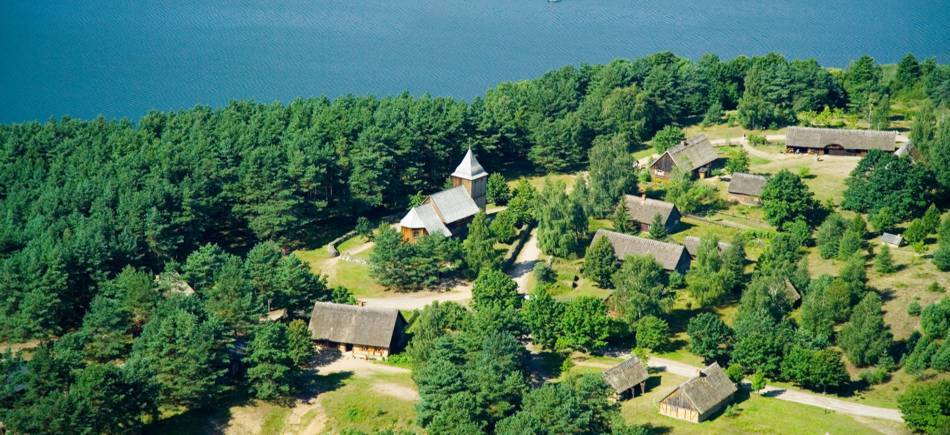
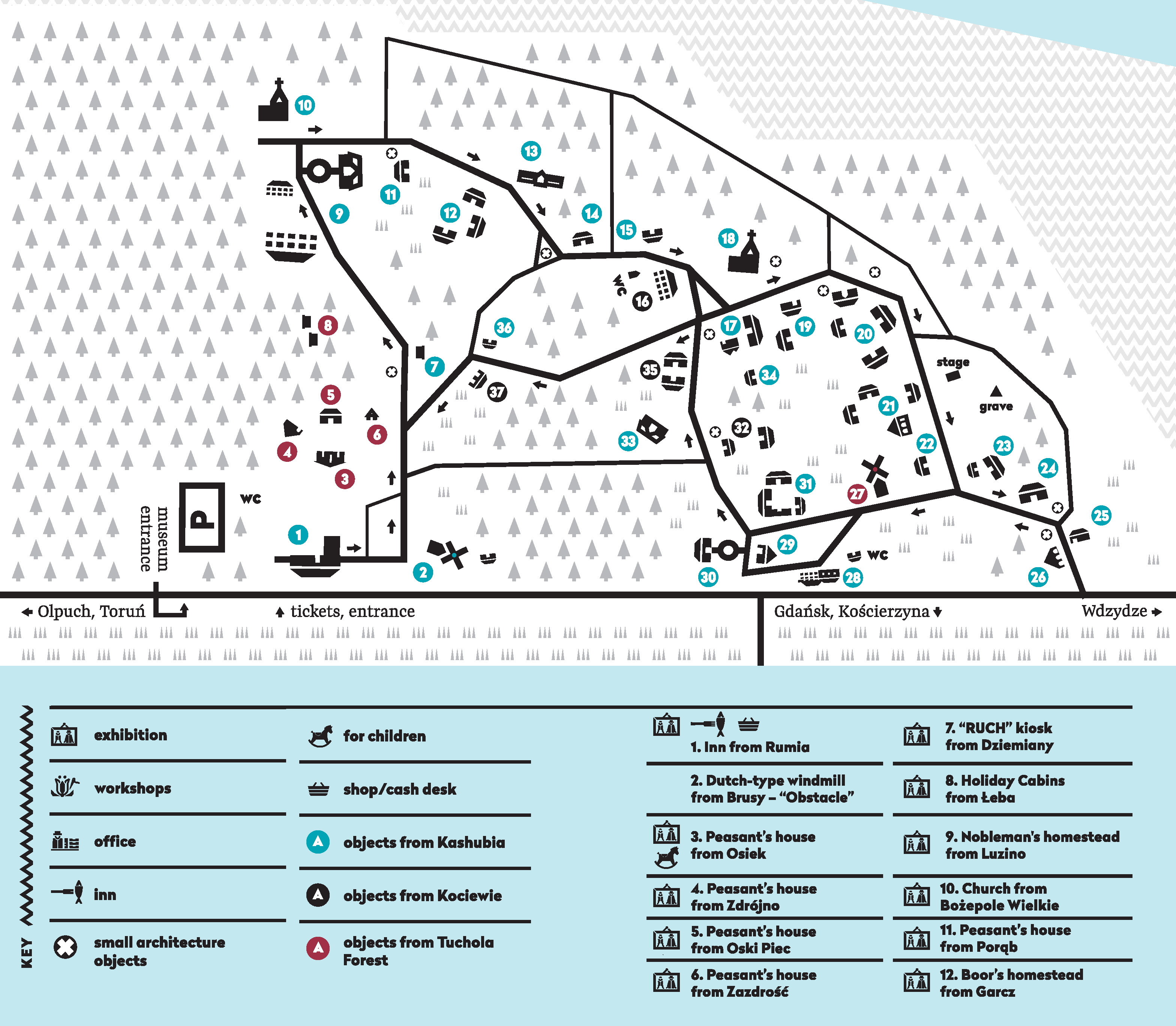
SOUTH AND WEST KASHUBIAN ARCHITECTURE
|
| 1. |
RICH PEASANT’S HOUSE
FROM WDZYDZE KISZEWSKIE - a reconstruction of 18th
century arcaded house which walls are made of beams joined cross-wise
at the ends, made in 1936. The interior is divided into a corner
vestibule, a room and a sleeping room equipped with traditional
furniture and working tools from the turn of 19th c. In
the corner of the room there is a heating stove made of clay
pot-shaped tiles.
|
| 2. |
FISHERMAN’S HOUSE FROM
WDZYDZE TUCHOLSKIE - built in the 20s or 30s of 19th c. It
shows the interior, after rearrangement at the beginning of 20th
c, with furniture and fishing equipment used by family of landless
peasants.
|
| 3. |
RICH PEASANT’S HOUSE
FROM CHRZTOWO - erected in 1852. It follows a typical style of rural
architecture of that period, i.e. the front wall overlooks the road.
The interior is preserved in the state from 1912. The internal part
of the chimney enlarged with back vestibule transformed into kitchen.
The rooms house an exhibition devoted to Teodora and Izydor Gulgowski
and handicraft from Wdzydze.
|
| 4. |
FARMSTEADFROM BORSK - from
the 80s of 19th c.,owned by family living by hired labour,
animal husbandry and craft. Within the farmstead there is a workshop
functioning since the 20s of 20th c.whose owner did some
wheelmaking, carpentry, boatbuilding, woodworking.
- HOUSE – broadfronted,
two-roomed, firnishing and utensils from the 20s and 30s of 20th
c.
- FARM BUILDING –
construction based on 19th c. tradition; initially a barn
with a mud floor; extended later with a workshop and two pigsties
|
| 5. |
RICH PEASANT’S HOUSE
FROM PIECHOWICE - built at the end of 18th c, rearranged in
the 80s of 19th c by decreasing the arcaded part. Now a
seat of folk artists and the choir "Wdzydzanki".
Exhibition: “Wdzydze Handicraft – Workshops”.
|
| 6. |
RICH PEASANT’S FARMSTEAD
FROM NAKLS - consists of a rich peasant's house, a worker's hut, a
pigsty, a barn, a well, a bread oven and a cellar.
- RICH PEASANT'S HOUSE from
Lipuska Huta, built in 1787. It has gable arcades, inside there is a
large vestibule, a room for the oldest of the family, a living room,
an alcove and a receptacle. The house is furnished with objects from
2nd half of 19th c.
- WORKER'S HUT transferred
from Nakla. It is a partly rebuilt 18th c. pigsty,
adapted for dwelling purposes in 2nd half of 19th
c. Under one common roof there are: a room with a vestibule, a
passage for carts and a small pigsty
- PIGSTY moved from Raduń,
built in 1905, with many partitions and a characteristic "bull's
eye" in the roof.
- BARN transferred from
Szablewo, built in 1748., two- mow, with a pass-through threshing
floor.
|
| 7. |
MINOR NOBLEMAN’S
FARMSTEAD FROM TRZEBUŃ - typical of 2nd half of 19th
c. and that social class villagers. Nearby a cross from Czapiewice
the end of 19th c.
- MANOR HOUSE from Trzebuń
built in the 20s of 19th c. for the Kopp-Ostrowski
family, the hereditary administrators of the village. Furnishing of
the dwelling and farming rooms is typical of small landowners from
the south-east Kashubia in the 80s and 90s of 19th c.
Next to the house, there is a replica of a pole wayside chapel.
- PIGSTY from Krosewo built
in the 1863 contains a four-part interior divided into a cart house,
a cow shed, a stable and a sheep-fold.
- BARN from the village of
Słone erected in the decline of 18th c., two-mow, with a
pass-through threshing floor.
- FARM BUILDING
“TORFOWNIK”from Tuszkowy – built at the end of 19th
c. Interiors intended to store fuel :firewood and peat, fishing
equipment and house utensils.
- POLE SHRINE – a replica
of a pole wayside shrine from 1869 with a Pieta inside. The original
sculpture displayed in the church from Swornegacie.
|
| 8. |
RICH PEASANT’S FARMYARD
FROM SKORZEWO consists of a house and a pigsty. Built in the first
half of 19th c. for the need of a rich peasant's farm. In
the 70s of 19th c. the farmyard belonged to a landless
family earning their living by hired labour.
- HOUSE from 2nd quarter of
19th c. In the Museum we show its state after the
rebuilding - the 30s of 20th c. Narrow-fronted with a
corner arcade, contains a vestibule, a living room, a room for the
oldest of the family with a tailor's workshop and an alcove with a
shoemaker's workshop.
- PIGSTY from the village of
Gorka, 1st quarter of 19th c. The rooms inside were
intended for firewood and poultry feeding stuff stores and a pigsty
with a henhouse. Nearby situated vegetable garden is enclosed by
hazel fence.
|
| 9. |
SMALLHOLDING FROM
SKORZEWO: furnishing from the beginning of 20th c.( built
in 1st half of 19th c.) consists of a house, a
farm building, cellars and a small chapel surrounded by a wall of
arranged field stones.
- HOUSE from about 1800 with
a characteristic annex for the oldest members of the family. Here a
"Kashubian Drzymala",i.e. Franciszek Peplinski was born. He
was standing in opposition to relinquishment of his Polish character
in those days. The annex houses temporary exhibitions.
- FARM BUILDING – from the
beginning of 19th c ( a barn and a pigsty together). The
gate of the barn is seated on wooden "rockers".
- FARM CELLARS of transom
bar construction, covered with turf.
- SMALL SHRINE with a modern
replica of an effigy of St. John Nepomucen. The original sculpture
dating from 19th c. from Mojusz village underwent some
preservation works and can be seen in the Museum collection.
|
| 10. |
CRAFTSMAN’S FARMSTEAD
FROM KALISKA – (planned to be extended)
- HOUSE – from the
beginning of 19th c.; arcaded, beams joined together
cross-wise at the ends, thatched roof; its owner was the so-called
“gromadzki sołtys” (village administrator)
- PIGSTY – from 1780 (
date visible on the door lintel in the arcade ), single-roomed with
an arcade supported by one post, construction beams joined together
cross-wise at the ends; used for animal husbandry in craftsman’s
farmstead.
|
| 11. |
MANOR HOUSE FROM NOWY
BARKOCZYN - built in 2nd half of 18th c.,
partly of carcass and partly of frame construction. Decoration from
the beginning of 19th c. The outstanding arcade with an added attic (
a room for a farm-hand ) constitutes a very distinct architectural
detail.
|
| 12. |
MINOR NOBLEMAN’S
FARMSTEAD FROM CZARNA DĄBROWA – ( reconstruction works in
progress) densely built-up area; included buildings were erected
successively between 70s of 18th c.and 1917. Thus, it its
a good illustration of development of folk Kashubian architecture.
- MANOR HOUSE- wall beams
joined together cross-wise at the ends; from the half of 19th
c.
- PIGSTY – stone and brick
from 1917, three-part ( cowshed, pigsty, kitchen with a bread oven).
Adapted for the needs of the exhibition
- PIGSTY – framework
construction from the 60s of 19th c.
- BARN – wall beams joined
together cross-wise at the ends, from the 70s of 18th c.;
a building with a gateway enabling to pass trough ( main entrance to
the farmstead), two mows separated by mud floor and a sheepfold
accessible from the gateway passage.
|
ARCHITECTURE OF CENTRAL KASHUBIA
|
| 15. |
RICH PEASANT’S HOUSE
FROM GARCZ (to be extended), an example of a wealthy farmstead where
animals were kept and land was farmed from 19th c
tradition; to be seen in the museum in the state from the 30s of 20th
c.
- HOUSE – from 1828;
timber framework with clay infill, thatched pitched roof flattened at
the gables, interior after modernisation of fire system ( kitchen in
the former chimney).
- PIGSTY – transferred
from Szopa, built in 1934; stone with shingled roof (“szyndle” –
a kind of thin shingles torn off from pine or spruce wood). One
interior divided into sections for cows, horses, pigs and hens.
- BARN- 1st half
of 19th c.; timber frame construction eith clay infill,
thached sloping roof.
|
| 17. |
FORESTER’S LODGE FROM
NOWE CZAPLE – ( restoration works in progress), funded by Prussian
forest administration 4th quarter of 19th c.
- FORESTER’S LODGE –
house with a basement of framework construction, multichambered.
Shape and plan imposed by forest administration
- OUTBUILDING - framework
and brick. Under one common roof section for animals and a barn.
|
| 21. |
MANOR HOUSE FROM RAMLEJE,
raised by Jozef Arendt from Kiełpino in 1945 on the site of a house
burnt during the Second World War, traditionally associated with
noble Puzdrowski family. The building is broad-fronted, its interior
is subdivided into separate rooms, framework construction of the
walls, gable and thatched roof. Inside there are workshops of the
Museum Section of Architecture.
|
|
ARCHITECTURE OF NORTH KASHUBIA
|
| 23. |
RICH PEASANT’S FARMSTEAD
FROM GNIEŻDŻEWO
SMALL SHRINE FROM PUZDROWO
– built in 1937, undertaking initiated by villagers, in 2005
bequethed to the Museum. Inside en effigy of Holy Mother of the
Rosary brought from Częstochowa in 1937.
|
| 26. |
NOBLEMAN’S FARMSTEAD
FROM LUZINO – (to be extended)
- MANOR HOUSE – 3rd
quarter of 17th c. Combination of timber framework
construction and wall beams joined together cross-wise multiply
rebuilt and modernised; interior multipartitioned with representative
chambers from the front. Exhibitions: “ Dwelling of Noble
Landowners in Kashubia from the Beginning of 20th c.”,
“Clean and Tidy Home at the end of 19th c. and the
beginning of 20th c.”, “ History of Farmstead from
Luzino”.
- GRANARY – from 3rd
quarter of 18th c. of framework construction with clay
infill. Exhibition : “ Poles, Germans, Kashubians. Photographic
pictures from life of Kashubian and Pomeranian village in 19th
and 20th c.” ( in cooperation with Herder Institute in
Marburg, Germany).
- PIGSTY – from 3rd
quarter of 19th c., multipartitioned building ( cowshed,
stable, pigsty, feed store), of stone with a tiled gable roof.
- BARN – from the end of
19th c., framework construction, plank coated, gable roof
covered with tar-paper.
|
ARCHITECTURE OF FOREST KOCIEWIE
|
| 34. |
FARMSTEAD FROM ZAZDROŚĆ
– ( to be extended), built at the beginning of 19th c.
in an amidstforrestrial settlement founded before 1780 in Bory
Tucholskie, the inhabitants worked mainly in forest industry,
minority dealt with farming and animal husbandry.
- HOUSE – built after
1802. Dwelt by landless people earning their living by hired labour
and craft works. Wall beams joined together cross-wise, protruding
ends. The roof covered with pine "darnice". One- room
interior, furnishing from 2nd half of 19th c.
- PIGSTY – from the
beginning of 19th c., wall beams joined together
cross-wise, thached, no partitions.
|
|
ARCHITECTURE OF FIELD KOCIEWIE
|
| 39. |
WORKER’S HOUSE FROM
KLONÓWKA – built for farm- workers in the 30s of 19th
c., out of small clay blocks with gable arcades.
Exhibition “ Florian
Ceynowa and Starogard Uprising of 1846”.
|
| 40. |
FARMSTEAD FROM SZCZODROWO
- two-building, formerly inhabited by farm-workers.
- HOUSE - built before 1874,
interiors from the 20s of 20th c. in the southern part a
village vet’s dwelling.
- PIGSTY FROM KLUKOWA HUTA
-built in 1897 by Kopica, a carpenter (from the area of Lipusz) by
order of a rich peasant employing farm-workers. Framework
construction of the walls, gable thatched roof.
|
| 41. |
RICH PEASANT’S FARMSTEAD
FROM POGÓDKI - is an example of a 19th c. stock
and land farm from Kociewie. It consists of a house and a barn.
- HOUSE built in the 70s of
19th c. Inside, around the central chimney, there are two
vestibules and four rooms.
- BARN FROM GRABÓWEK
- built in 1749 , two-mow, divided by a pass-through threshing
floor. Extensions of wattle and daub construction were used as
pigsties.
- "BOŻA MĘKA"(
CHRIST'S PASSION ) a copy of an original folk cross from 1889,
belonging to this farmstead. The restored original can be seen in the
Museum collection.
|
INDUSTRIAL AND PUBLIC
BUILDINGS
|
| 44. |
WINDMILL "KOŹLAK"
FROM JEŻEWNICA - built in 1876 by a master carpenter Ladwich. It is
equipped with traditional grinding devices and more modern ones
introduced in the 20s of 20th c.
|
| 45. |
WINDMILL "HOLENDER"
(A Dutchman) FROM BRUSY built in 1876 built.It is constructed of
wooden parts of an old belfry, modernised in 1914, used until 1947.
It is raised on octagonal site plan, three-storey interior, movable
roof. The windmill is equipped with a large spindle wheel seated on a
wing roller.
- AUXILIARY SHED – a copy
of a shed from Rolbik of timber-frame construction. Inside a roll
turnery used for renovation of metal parts of a grain grinder and a
traditional oil press ( oil was made from toasted linseed)
|
| 46. |
SAWMILL FROM STANISZEWO -
with a horizontal frame, the sawing machine was constructed in
Bydgoszcz by "C.Blume and Son"factory in the end of 19th
c. Formerly it was driven by water wheel or a steam engine.
The roof is a reconstruction of an original sawmill roof.
|
| 49. |
VILLAGE SCHOOL FROM
WIĘCKOWY - built in the 50s of 19th c. with walls of
frame construction. Typical design of that period divides the
interior into a big classroom for about 100 children and a dwelling
for a teacher. Here you can see a reconstructed classroom from the
period between the Two World Wars.
- FARM BUILDING FROM
KALISKA – the 80s of 19th c., timber-frame construction
with brick infill
|
| 50. |
CHURCH FROM SWORNEGACIE -
dedicated to St.Barbara, funded by the starosty of Tuchola, the
villagers and the parish-priest from Konarzyny. Built about 1700 has
a characteristic three-segmental compact construction. Its walls have
got framework construction, the roof is shingled. The belfry of
framework construction was added in 1740. Next to the church there is
a copy of a cross from Wieprznica from the year 1766.
- HIGH ALTAR from 3rd
quarter of 17th century with paintings depicting
St.Barbara and John the Baptist, from the beginning of 18th
c.
- SIDE ALTARS, the right one
rococo-classicistic from 18th c.and the left one,
classicistic from 19th c.
Wooden ceiling is covered
with paintings from the beginning of 18th c. representing
St.Barbara, John the Baptist and The Eye of Providence in rich floral
ornaments. The whole corresponds to baroque tradition and emphasises
the folk character of the interior.
|
| 51. |
SMALL MANOR HOUSE FROM
SKWIERAWY - built at the beginning of 18th c. The
interior arranged for the reception needs of the Museum: a
box-office, a souvenir shop and the exhibitions : introductory , and
a permanent one "Old Furniture in Kashubia".
|
| 52. |
SMALL MANOR HOUSE FROM
RADUŃ - erected in the 50s of 19th c., founded by
Lew-Kiedrowski family, outstanding in the village because of a large
and modern construction, it immitated the classicistic manor houses
fashionable in the middle of 19th c. Here there are
workshops and offices of the Museum.
|
| 55. |
SMITHY FROM LINIA - built
at the beginning of 20th c. Framework construction of the
walls , gable roof covered with roofing paper, used until the 80s of
20th c.
|
| 58. |
LEASEHOLDER’S HOUSE FROM
STARA HUTA – timber-frame construction; built in the 90s of 19th
c; in the Museum adapted for the needs of a folk inn “Wygoda”.
|
|
THE MUSEUM FOUNDERS’
GRAVE:
- Izydor Gulgowski, born in
1874 at Iwiczno, died in 1925.
- Teodora Gulgowska, nee
Fethke, born in 1860 at Małe Chełmy, died in 1951.
|
|
MONUMENT to “The
Founders of Kashubian Skansen" ( Teodora and Izydor Gulgowski ),
sponsored in 1977 by Kashubian-Pomeranian Association, designed by
Wawrzyniec Samp.
|
|
MONUMENT TO RÓŻA
OSTROWSKA – a writer attached to Wdzydze; sponsored in 2005.
|